

 Even the most effective antimicrobial stewardship program can fall short if the social and economic factors affecting patients are not addressed.
During the Thursday session “Uncovering Socioeconomic Disadvantage in Antibiotic Use and Infections,” speakers examined how social determinants of health influence antibiotic use, infection risk and stewardship outcomes, and discussed ways programs can better account for those factors.
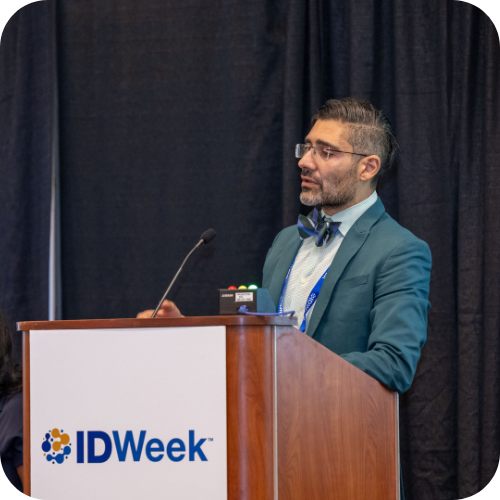
Mayar Al Mohajer, MD, MPH, FIDSA, medical director of Infection Prevention and Antimicrobial Stewardship and a professor at Baylor College of Medicine, highlighted evidence showing that socioeconomic disadvantage can contribute to both antibiotic overuse and underuse. Studies have found that people who are unemployed, live in crowded households or lack access to transportation are less likely to receive appropriate antibiotic therapy and may face a higher risk of infections such as those caused by methicillin-resistant Staphylococcus aureus, he said.
Despite those challenges, stewardship interventions can improve outcomes.
“Until we have a robust national and state intervention, we rely on our local efforts,” Dr. Al Mohajer said. “We know it works. Hospital stewardship intervention can reduce antibiotic use and improve adherence.”
He noted that adherence to Infectious Diseases Society of America prescribing guidelines has been associated with improved outcomes, including fewer hospital revisits and lower mortality.
Health System and Structural Factors
Valeria Fabre, MD, associate professor of medicine at Johns Hopkins University, broadened the discussion to include health system and structural factors that affect stewardship efforts globally.
Among the studies she cited was an analysis showing that approximately one-quarter of surgical prophylactic antibiotic use did not adhere to guideline recommendations, with greater nonadherence associated with a higher risk of surgical site infections.
The problem is not limited to resource-constrained settings: In an Australian study, surgeons and anesthesiologists cited limited education about guidelines as a major barrier to adherence. In lower-resource settings, however, barriers were often structural, including shortages of recommended antibiotics.
Dr. Fabre highlighted opportunities to improve stewardship through stronger collaboration with surgical teams. Referencing a study from the United Kingdom, she emphasized the importance of increasing stewardship presence in surgical settings and, as she put it, the need to “step up in surgery and improve our visibility.”
Across settings, she said, communication and relationships were among the most important drivers of stewardship success. She pointed to research comparing high- and low-performing facilities in efforts to reduce urinary tract infections and community-acquired pneumonia. High-performing sites were more likely to have stewardship expertise, accessible guidance, institutional support, strong pharmacist-physician relationships and infectious diseases physicians who actively championed stewardship practices.
Social Drivers of Antimicrobial Resistance
Zanthia Wiley, MD, professor of medicine at Emory University, focused on the broader social drivers of antimicrobial resistance and infection risk.
“Social determinants amplify the risks and outcomes,” Dr. Wiley said. “We can talk data and show figures. But if we don’t show the social determinants, we’re not going to be able to make that much of an impact.”
She described many stewardship interventions as addressing only “the tip of the iceberg,” such as prescribing practices and antibiotic utilization. Beneath the surface, she said, are factors including animal health, susceptibility to infection, access to vaccination and environmental conditions that also contribute to antimicrobial resistance.
Although the scope of antimicrobial resistance can seem overwhelming, Dr. Wiley encouraged attendees to identify opportunities for action within their own spheres of influence. Improving vaccine communication, for example, can help increase vaccination rates and reduce infection risk.
“This is a tiny drop in the antimicrobial resistance ocean, but we have to have as many drops as possible,” Dr. Wiley said. “Tackle what you can, and seize every opportunity.”
Photo: Mayar Al Mohajer, MD, MPH, FIDSA, discussed how socioeconomic factors can lead to both overprescribing and underprescribing of antibiotics at a Thursday session.