
 Addressing the shortage of infectious diseases physicians may begin long before residency, with efforts to engage students early in medical school and provide sustained mentorship throughout training.
“When we think about recruitment, we often think about residency or fellowship,” said Archana Reddy, MD, assistant clinical professor at the University of California, Davis Health, at a Friday session. “But by then, many have started creating their identities. The first spark matters, and we are often the people holding the match.”
Speakers at the session, “Building the Pipeline Early: How to Recruit Into Infectious Diseases Through Undergraduate Medical Education,” discussed strategies for attracting students to the specialty.
“I asked myself, ‘Why am I giving this talk?’ I’m a course director,” Dr. Reddy said. “Every year, I noticed the same thing: Students would hang around after class, ask insightful questions and tell me they want to shadow.”
Last year, Dr. Reddy launched an ID interest group after seeing sustained student engagement outside the classroom. That group attracted 11 students, representing about 10% of the medical school class.
“Will they all become ID physicians? Probably not,” Dr. Reddy said. “But what we think of as a required microbiology course may be one of the earliest and best recruitment tools we have as a specialty.”
She cited research showing that 65% of graduates developed interest in their subspecialty during medical school or earlier.
“Curriculum isn’t just transferring knowledge,” Dr. Reddy said. “It’s helping students determine whether they belong in the field. They ask questions like, ‘Do I belong here? Can I see myself doing this?’ ”
She noted that ID naturally encompasses topics that often attract students to medicine in the first place, including HIV care, public health, global health and health equity.
Recruiting Physician-Scientists
Jatin Vyas, MD, PhD, director of physician-scientist programs at Columbia University Vagelos College of Physicians and Surgeons, discussed another workforce challenge: recruiting physician-scientists into infectious diseases.
“We believe that the future of medicine does depend on physician-scientists,” Dr. Vyas said. He noted that the proportion of physicians involved in research has fallen from approximately 5% to 1% of the physician workforce.
Pursuing a combined MD-PhD degree involves “a long path that is accentuated with a lot of uncertainty,” Dr. Vyas said. Compensation concerns can present an additional barrier, particularly for infectious diseases careers.
Still, he believes emerging scientific opportunities could help attract more trainees.
“As we start to look at harder-to-treat infections, we need to encourage our students to think beyond being the antibiotic jockey,” Dr. Vyas said. “I’m hoping we’ll see a paradigm shift in ID that moves from a pathogen-centric focus to a host-centric approach, recognizing that the host’s immune state shapes everything we see. These are the types of concepts that get students very excited about ID.”
Early Exposure and Mentorship
Andres (Andy) Bran, MD, FACP, FIDSA, associate professor of medicine at the University of Missouri-Columbia, emphasized the importance of early exposure and mentorship.
Research has shown that only about one-third of medical schools have an ID interest group, and many students are uncertain about infectious diseases opportunities available at their institutions.
“When a student reaches out, we need someone ready to respond,” Dr. Bran said. That support can take multiple forms, including mentorship, coaching and sponsorship. “Sometimes they simply need advice about what electives to take” or to talk with someone who has struggled before and for that person to be open and kind.
Dr. Bran said outreach should begin well before medical school. He works with high school students to help them envision careers in medicine and infectious diseases. Once students enter medical school, those connections can provide pathways for deeper engagement with the specialty.
“An interest in ID needs somewhere to go,” Dr. Bran said. “There is a real opportunity for someone who takes that interest seriously and can offer support that continues throughout training. Creating that path is something we all share. We know why this specialty matters. Let’s make sure that the next generation has the opportunity to discover that.”
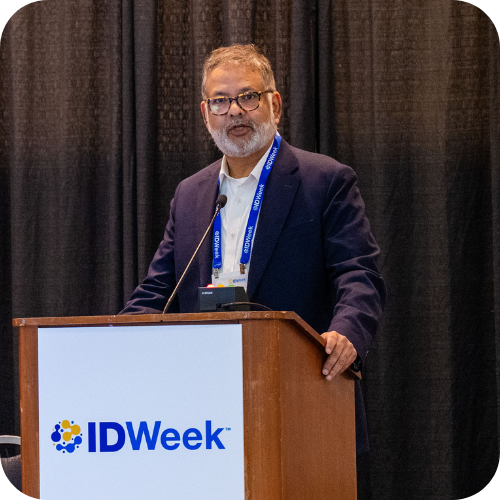
Photo: Jatin Vyas, MD, PhD, director of physician-scientist programs at Columbia University Vagelos College of Physicians and Surgeons, highlighted challenges and opportunities in recruiting physician-scientists to the field of ID.