

 Hand hygiene is a cornerstone of patient safety. Yet research suggests that the sinks and plumbing systems that support handwashing can also serve as reservoirs for dangerous pathogens.
Sinks, tap water and the microbial environments they create were the focus of the Friday session “Plumbing the Depths: The Hidden World of Waterborne Pathogens in Health Care.”
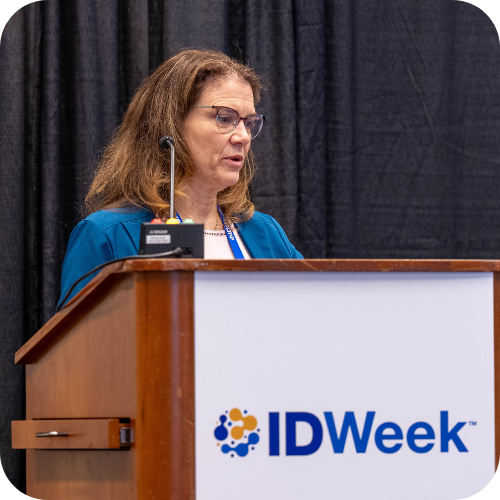
Amy Mathers, MD, professor of medicine and pathology at the University of Virginia, explored waterborne pathogen contamination in sinks and plumbing systems. “We’ve been increasingly recognizing that drains, sinks, toilets and environmental water sources are associated with more than Legionella. It might be other pathogens as well,” she said.
Much of Dr. Mathers’ research has centered on a sink laboratory, where investigators study the sanitary stack, the plumbing system that carries wastewater out of a building. “All plumbing is essentially gravity,” she said. “It makes a nice environment for organisms to thrive.”
After several interventions proved unsuccessful, researchers built a sink laboratory to create a more controlled testing environment. One early finding showed that Escherichia coli could migrate from one sink to another through the sanitary stack, moving across biofilm in search of nutrients.
Using mannequin hands to mimic real-world conditions, researchers also found that preventing water from striking the drain plate in the sink reduced pathogen dispersion.
Those findings led to changes in the hospital environment, with a focus on keeping patient care items away from sinks.
“We worked very hard to redesign our work environment in the ICUs so that people don’t put anything on the sinks,” Dr. Mathers said. Additional work has focused on minimizing the sink “splash zone.”
Focusing on Sink Use
In another study, researchers used motion-activated cameras to monitor sink use in intensive care units. “The reason these sinks are in the patient care environment is for hand hygiene,” Dr. Mathers said. “What we found is only 14% of the time were people using the sinks for hand hygiene.”
Instead, staff frequently used sinks to dispose of patient care-related liquids, including nutrition shakes and soft drinks. Researchers found that nutrient-rich waste appeared to promote the growth of carbapenemase-producing Enterobacterales.
“When the sinks were transplanted back to the lab, the CPE was disappearing,” Dr. Mathers said. “As soon as we started adding amino acids, immediately, [it was] positive again.”
Researchers also observed that rooms housing patients with Clostridioides difficile were less likely to have CPE in sink drains. “If you have C. difficile in a modern hospital, people are using a lot of water,” Dr. Mathers said. “We took that back to the sink lab.”
The team found that frequent use of chlorinated water could help prevent bacterial growth in sinks.
Determining Where Sinks Are Needed
Arthur Baker, MD, MPH, associate professor of medicine in the Division of Infectious Diseases at Duke University School of Medicine, examined whether sinks are necessary in intensive care units at all. He discussed sink-free patient zones and the use of controlled water sources, such as sterile or filtered water, instead of tap water.
Dr. Baker cited studies from multiple countries that evaluated the impact of removing sinks and implementing waterless patient care across a range of pathogens.
“We do need more data to understand the value of these interventions that take a lot of leg work,” he said. “Do we have enough data to say every ICU needs to remove the sink and stop using tap water? I’m not sure that we’re there.”
Still, during outbreaks, removing sinks may help interrupt pathogen transmission, he said.
Dr. Baker acknowledged that eliminating sinks would create significant challenges for patient care, including bathing, drinking water access and oral medication administration.
Photo: Sinks and pipes can harbor numerous pathogens, according to Amy Mathers, MD, professor of medicine and pathology at the University of Virginia, who discussed research projects in a sink laboratory.