

 As funding cuts ripple through global health programs, speakers at a Wednesday session argued that the future of international research and education partnerships will depend less on outside dollars and more on local ownership, reciprocity and equitable collaboration.
Each of the panelists at the session “Building Equitable Research and Education Partnerships in Infectious Diseases” discussed the impact of funding challenges while sharing the success of a variety of programs across the world. But the speakers primarily highlighted that programs continue — and continue to be vital — regardless of what government funding does.
“Of course, financial support is critical. But funding is not the biggest part of the puzzle,” said Dawd Siraj, MD, MPH, professor of medicine at the University of Wisconsin. “The real test of sustainability comes [in determining] whether local institutions can continue with what has been done. The gradual transition of those programs to local ownership, that is the standard by which I want you to define sustainability.”
Dr. Siraj discussed his 35 years of work in global health, focusing on programs in Ethiopia and Rwanda and his six pillars for success.
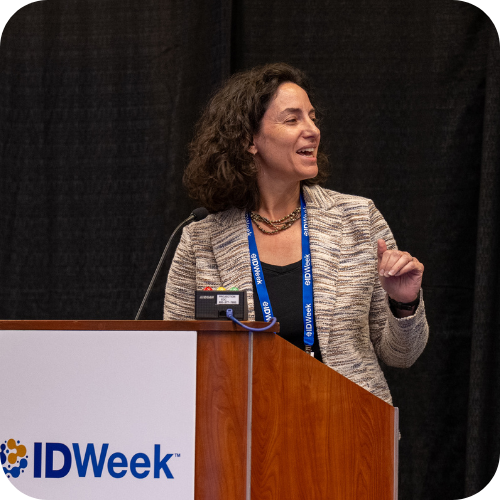
Tracy Rabin, MD, SM, associate professor of medicine and director of the Office of Global Health at Yale School of Medicine, provided updates on bilateral clinical exchanges, focusing on her work in Uganda, where Yale has partnered with Makerere University to train faculty.
“Even though we strive to be equitable, there remains a gap in our model,” Dr. Rabin said. “It’s the fact that there are U.S.-based regulations that prevent [those international physicians] from doing hands-on clinical training.”
Challenges at the federal, state and institutional levels are not set in stone, however. A working group is tackling the issue head on, working on federal legislation, state medical board changes and institutional guidance to allow short-term training programs for supervised, hands-on patient interactions. The intention is for “clinical capacity building,” Dr. Rabin said. “They come, train and bring that back to their institutions, and develop further from there.”
Authorship in Journals, Bidirectional Partnerships
Chelsea Modlin, MD, assistant professor at Johns Hopkins University, shared research evaluating authorship in journals, finding gaps among those who are based in the global south.
“Authorship is about showing respect for one another as well as acknowledging what others are contributing to the work,” Dr. Modlin said, noting the impact on both grants and career growth.
Nadia Sam-Agudu, MD, CTropMed, professor of pediatrics (infectious diseases), and director of the Global Pediatrics Program at the University of Minnesota Medical School, laid out guidelines for building ethical bidirectional partnerships. She noted that bilateral partnerships may be more commonly used, but bidirectional better reflects the “functionality of that partnership that it has built-in reciprocity and equity.”
Ethical bidirectional partnerships “strengthen ethical leadership and help build a culture of ethical behavior,” Dr. Sam-Agudu said. “You want to train people to come work with anyone, anywhere. It promotes innovation in research and education and improves development at the hosting institution. It builds a track record of research and education that will hold up to scrutiny in the future."
Partner institutions want this level of ethical partnerships as well, she said, noting that infectious diseases clinicians should lead the way in creating these types of partnerships.
Photo: Tracy Rabin, MD, SM, associate professor of medicine and director of the Office of Global Health at Yale School of Medicine, discussed her work in Uganda, where Yale partners with Makerere University.