

 As infectious diseases physicians look for new ways to demonstrate value and expand their role in patient care, some are finding success through multidisciplinary service lines.
During the Saturday session “Stronger Together: How to Build a Subspecialty ID Service Line to Deliver Effective Multidisciplinary Care,” speakers described programs that embed ID expertise within obstetrics, orthopedics and endocarditis care, improving coordination and patient outcomes.
The session grew from conversations about the future of the specialty, said moderator Taison Bell, MD, MBA, associate professor at the University of Virginia. “What does ID need to do to establish increased relevance and increased compensation?” Dr. Bell asked. “We thought, what about multidisciplinary care?”
Maternal HIV Treatment and Prevention
Jennifer Jao, MD, MPH, professor at Northwestern University Feinberg School of Medicine and director of the Section of Pediatric, Adolescent and Maternal HIV Infection at the Ann & Robert H. Lurie Children’s Hospital of Chicago, focused on caring for pregnant women with HIV and their infants.
“It’s really complex when you have to provide care for a woman-child dyad,” Dr. Jao said.
Clinicians must manage maternal HIV, evolving antiretroviral therapy recommendations, infant prophylaxis and postpartum follow-up while caring for both mother and child. “You’re trying to care for two patients, the mom and the baby,” she said.
Although many women remain highly engaged in care during pregnancy, retention often declines after delivery. Historically, feeding recommendations have also evolved. Current guidance recommends supporting women with sustained viral suppression in their decision to breastfeed or not to breastfeed.
Care fragmentation becomes a major challenge once the baby is born in a typical scenario. “After the baby is born, mom goes to the internist, baby goes to the pediatrician,” Dr. Jao said.
At Northwestern, a dedicated obstetric-ID clinic helps bridge those transitions. The program relies on close collaboration among adult ID, pediatric ID and obstetric providers, with services physically located near one another to reduce barriers for patients.
“You have to have close collaboration with your adult ID, peds ID and OB providers,” she said. Co-location matters, but communication matters even more. “You have to pick up the phone and talk to each other.”
Musculoskeletal Infections
Julie Reznicek, DO, FIDSA, associate professor in the Division of Infectious Diseases at Virginia Commonwealth University, described a similar approach in musculoskeletal infections. “We have so much worth, but are the worst at marketing ourselves,” Dr. Reznicek said.
To improve collaboration with orthopedic surgeons, she established an ID clinic within the orthopedic clinic itself. Being embedded within the practice has strengthened relationships with surgeons and improved care for patients with prosthetic joint infections, diabetic foot infections and chronic wounds.
“You have to be with the orthopedic team, or they won’t integrate you into their practice,” she said.
Dr. Reznicek argued that ID physicians should understand the priorities of their surgical colleagues, including reducing length of stay, readmissions and unnecessary procedures. She also encouraged physicians to become active members of the departments they support through teaching, committee work and regular participation in conferences.
Successful partnerships depend on clear communication — and with surgeons, that means learning to speak in their manner. “Bullet it,” she said of consult recommendations.
She also stressed the importance of recognizing the significant burden musculoskeletal infections place on patients, many of whom endure years of pain, repeated operations and disability. “We’re even more important to the patients,” she said.
Endocarditis
The value of structured collaboration was further highlighted by Sami El-Dalati, MD, associate professor of internal medicine and director of the multidisciplinary endocarditis program at the University of Kentucky.
Using a case of suspected methicillin-resistant Staphylococcus aureus endocarditis, Dr. El-Dalati described how patients can experience delays in care when ID physicians, cardiologists and surgeons operate independently. “Every day matters,” he said.
Endocarditis affects approximately 40,000 patients annually in the United States and frequently requires coordinated decision-making regarding surgery, device extraction and antimicrobial therapy.
Evidence supporting multidisciplinary endocarditis teams helped shape the University of Kentucky’s program. The team includes ID physicians, cardiac surgeons, cardiologists, neurologists, pharmacists, nurse navigators and social workers. Given the state’s burden of opioid use-associated endocarditis, addiction medicine and palliative care specialists are also involved.
The team meets weekly to review every hospitalized patient with endocarditis and supports a dedicated ID consult service focused on care coordination and follow-up. Since launching in 2021, the program has reviewed more than 900 cases.
Dr. El-Dalati reported that mortality fell from 29% to 7% after implementation of the multidisciplinary model. Outcomes also improved among medically managed patients. The program has since expanded into outpatient care, rural outreach and research, producing more than 35 peer-reviewed publications.
Across the three program areas shared during the session, speakers emphasized that multidisciplinary care works best when ID physicians become integrated partners rather than outside consultants. The common elements were communication, visibility and shared accountability.
When ID specialists build strong partnerships with other disciplines, patients benefit and the value of the specialty becomes easier to see.
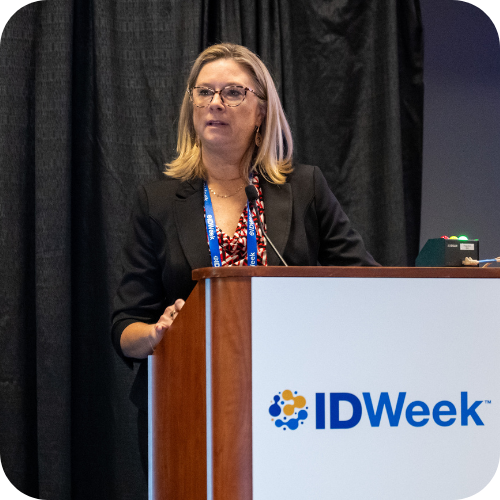
Photo: Julie Reznicek, DO, FIDSA, associate professor in the Division of Infectious Diseases at Virginia Commonwealth University, described successes in integrating ID into an orthopedic clinic.