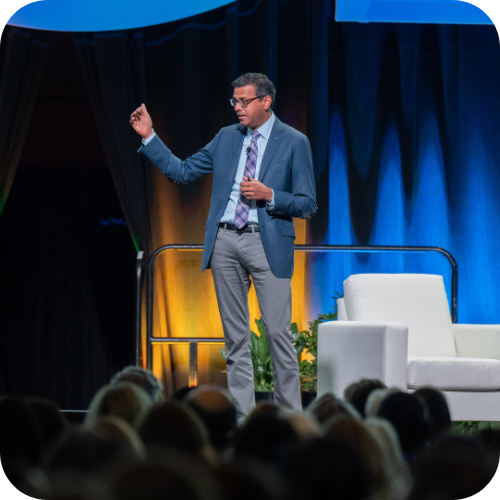
 When Atul Gawande, MD, MPH, joined USAID in 2022, he expected a chance to help shape global health policy. What he did not expect, he told attendees at IDWeek’s opening plenary Wednesday, was to discover “the best job in medicine” he had ever had.
Reflecting on the agency’s six-decade legacy and its abrupt dismantling, Dr. Gawande recounted the lives saved through U.S. global health investments while challenging the infectious diseases community to preserve that progress through continued collaboration and innovation. He was assistant administrator for global health at USAID from 2022 to 2025.
Now the Fish Chair in Surgery at Brigham and Women’s Hospital and the Samuel O. Thier Professor of the Practice of Surgery at Harvard Medical School, Dr. Gawande is also Professor of the Practice at Harvard T.H. Chan School of Public Health.
When USAID funding was eliminated by presidential executive order in 2025, it put an end to a program begun in 1961 by President John F. Kennedy. “It was a lesson he learned from the Marshall Plan,” Dr. Gawande said. “We invested in people we had just defeated.”
Health was the key for both humanitarian reasons and for societal reasons, to create stability. USAID began first attacking the “pernicious injustice” of lifespan differences in children around the world.
A Broad, Global Legacy
USAID worked to spread cholera treatments, a steady work that reduced diarrheal disease deaths by 90% worldwide. The organization helped deliver six vaccines around the world, adding 16 years to the average global lifespan. It oversaw the launch of GAVI, the vaccine alliance, and the U.S. President’s Emergency Plan for AIDS Relief. “It was commitment like we’d never seen to global health,” Dr. Gawande said. “This did more to increase our security than anything we have done with a gun.”
The impact was broad, he said, citing figures that showed drops in childhood deaths, much of that due to vaccines — the measles vaccine in particular.
“The surprise to me, when I got to USAID, was in seeing what 60 years of investing in these countries led to, and seeing what happened as they transitioned to middle income.”
Those countries, as they prospered, invested in public health, he said, leading to “extraordinary results.” He cited countries that had come to match or exceed life expectancy in the United States.
Acknowledging “legitimate criticism” of USAID for fostering dependence or aligning aid with U.S. military or political aims, he praised the organization for saving “more lives per dollar than just about any agency in the U.S. government.”
“We Are Not Back at Square One”
When funding for USAID was eliminated, and the agency ultimately ceased all operations, “it was clear that massive numbers of people would die,” Dr. Gawande said. He cited cessation of primary health care clinics and what is projected to be an increase in child deaths — for the first time in half a century. “This is public, man-made death,” he said.
In keeping with opening plenary’s title — “Together We Rise: Courage, Collaboration and the Future” — Dr. Gawande ended on a hopeful note.
“We are not back at square one,” he said. “The knowledge of what has been able to be accomplished is widely recognized. The goal of finishing the job on child and maternal mortality, stopping the killer infectious diseases and realizing that roughly one of eight diseases of cancer around the world is linked to an infectious disease, this is not partisan.”
A panel discussion followed his presentation, focusing on the collaborations that are trying to fill the void left by the shuttering of USAID and other changes in federal policy.
Jeanne Marrazzo, MD, MPH, FIDSA, CEO of the Infectious Diseases Society of America, moderated the discussion, which included Georges Benjamin, MD, MACP, FACEP (E), FNAPA, CEO of the American Public Health Association; Sandra Fryhofer, MD, MACP, president-elect of the American Medical Association; Richard Hatchett, MD, CEO for the Coalition for Epidemic Preparedness Innovations; and Jessica Malaty Rivera, MS, executive director at the Infodemiology Initiative at the Public Good Projects.
Photo: Atul Gawande, MD, MPH, who was the assistant administrator for global health at USAID from 2022 to 2025, highlighted USAID’s achievements and legacy during the IDWeek opening plenary.